Tour the Baths of Caracalla: A Guinness Book of World Records Spa
What will a private tour of the Baths of Caracalla offer you?
Without a doubt, a private tour of the Baths of Caracalla will offer you some stupendous lessons in architecture and engineering! And we’ll talk more about that in a minute. Furthermore, a private tour of the Baths of Caracalla will feel private! What do I mean? The “Top-Ten” sights in Rome are usually crawling with tourists. Luckily, this is not one of those places. (Probably because Ridley Scott didn’t make a movie about it.) So, despite the Baths of Caracalla’s uniqueness and grandeur, you’ll be one of the few visitors there.

What Makes the Baths of Caracalla So Special?
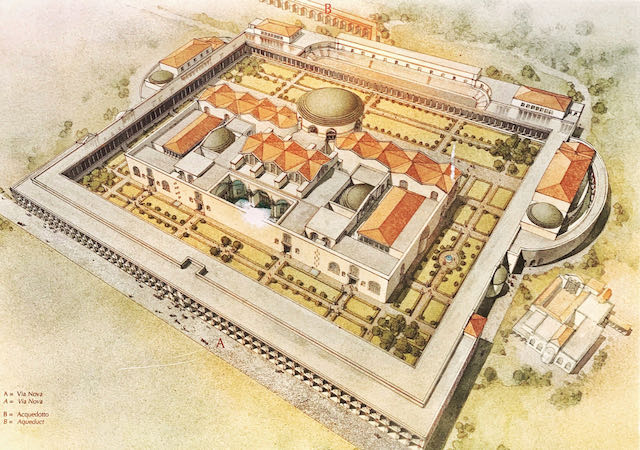
Well, I dunno. Just the fact that they were the largest public baths in Rome when they were first opened in circa 215 A.D. But you’re asking yourself, “How large could large possibly be?” Well, let’s compare them to something very large and more modern, like Saint Peter’s Basilica. The Baths were 214 meters (i.e. 702 feet) long and its width was pleasantly proportionate to its length. Meanwhile, Saint Peter’s Basilica is just 187 meters long, i.e. roughly 614 feet — or a tad less than 100 feet shorter than the Baths of Caracalla! (I will admit that this measurement does not include Saint Peter’s porch, which makes the whole shebang 6 meters or a little more than 18 feet longer than the Baths.) Those numbers may help you put the southwestern wall into perspective, i.e. the wall that is shown “before and after” in the picture above (which I admit to having cribbed from this site.)
How Do the Baths of Caracalla Compare with Other Guinness Book of World Record Imperial Buildings?
During our private tour, we’ll compare the Baths to the Pantheon. Remember that the Pantheon was and still is the largest standing, un-reinforced solid concrete dome in world history. Now, that string of qualifiers is important. There are larger domes in different materials (like the masonry one over Florence’s Cathedral or Virginia’s Norfolk Scope, made in reinforced concrete and thanks to the vision of a genius Italian architect).
But why talk about the great ambitions of the engineer who designed the Pantheon? Especially when Emperor Caracalla’s engineer was pushing concrete technology to unthinkable limits a little over one hundred years later! The traces of its monumental cross vaults will take your breath away. The picture to the right is an accurate hypothetical rendering of what they looked like. I scrounged it off of this website. Now think for a second… Have you seen ceilings like that before?


Oh, of course you have! Look no further than New York’s Penn Station — that is, the first version that was knocked down in 1960 to make way for the modern one. This old picture of Penn Station shows how this and other imperial baths inspired architects across the centuries — and in different continents.
One Last Observation about the Baths of Caracalla…
During our private visit to the Baths of Caracalla, I will emphasize an important point: Ancient Romans had several words for public baths, like: balneum and thermae. The standard English translation of those words is, as you know, “baths.” Now, bear with me a moment. When you read the word “bath,” what comes to mind? From experience, I know that most people think of bathtubs. Or a bathroom. Or a small pool. Not much more. Unfortunately, the conventional translation of thermae has ruined our understanding of what they were.
Two of the better translations of thermae are “Y.M.C.A.” and “spa.” If I called Caracalla’s giant complex a spa, you would already feel yourself melting into the hot waters of its jacuzzi. Or maybe you’re dreaming about a massage. The spa experience could include sipping herbal tea in one of the heated rooms or having unwanted hair tweezed. And if we called the establishment “Caracalla’s Y.M.C.A.,” you envisage the weight room, wrinkle your nose in the locker room, and wish you had dark sunglasses to stare more subtly at some of the more stunning patrons.
And get this, mens sana in corpore sano, “a sound mind in a sound body” meant exactly that. So, Caracalla’s establishment dripped in beautiful interior decoration and artwork – some of which has survived centuries of “recycling efforts” and can still be seen in and around Rome and in some museums. Its libraries would keep you busy, if there wasn’t a recital or a conference going on in one of its many halls. Intrigued? Join me at Caracalla’s Y.M.C.A./Cultural Facility, where we’ll discuss art, architecture, and the habits of the average Roman with a couple of hours off.
Ready to Book This Tour?
Get in touch with Daniella to check availability and start planning — just mention "Tour the Baths of Caracalla: A Guinness Book of World Records Spa" in your message.
Get in Touch